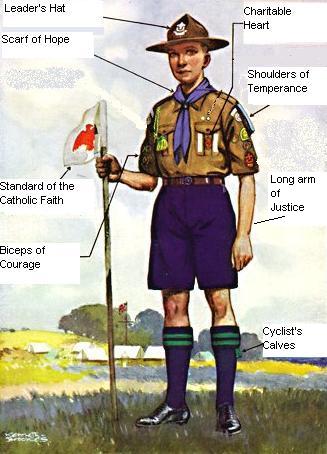
(Kenneth Brookes. Boy Scout Uniform And Badges. Source)
Let's Adore Jesus-Eucharist! | Home >> Philosophy
(Kenneth Brookes. Boy Scout Uniform And Badges.
Source)
The word "value" has these days a mind-boggling popularity. As soon as a speaker attempts to rise above the daily grind, above the mere bean-counting of our daily routines, he almost invariably uses the word "value". As soon as a politician wants to cause the righteous anger of a crowd, he asserts that the enemy means harm to our "values". But what is this "value" thing?
Even if you don't realize, when you use the word "value", you probably do it because you're being influenced by a philosophical school of though which started with Friedrich Nietzsche (1844-1900), the Pragmatist and Values-Theory School, and even in a way Nazi Germany [Thonnard, Précis d'histoire de la philosophie].
When some philosophers had the wool pulled over their eyes by Kant, the word "value" was popularized as a replacement for the word "good". Indeed, if (as Kant wrongly claims) we cannot know metaphysical truth, then by the same token we can't strictly speak of "good" or "evil" anymore. How can we claim something is truly a good, if we can't know truth?
Many people therefore started to use the word "value", since it has a more psychological twist. Indeed, anything can, for us, subjectively, seem to have more or less value. Some bad philosophers therefore jumped on what seemed to be a substitute for "good".
In many cases, there is nothing wrong with the word "value". For example, if you say "the Canadian dollar lost some value today", the word "value" is correctly used.
But beware of the word "value" when it's accompanied by a possessive:
- "In the Ethics course, we learn to choose our value system";
- "That is against my values";
- "You have your values, I have my values";
- etc., etc.
One of my favorite stories about values comes from one of my Philosophy teachers, Mr. Murray. A little boy, from some family connection, had contacted him for help with his homework at school, which was about values. Mr. Murray told him to list the following three values:
- My value #1: To avoid having a hierarchy of values;
- My value #2: To avoid respecting my values;
- My value #3: To avoid respecting other people's values.
Apparently the teacher didn't find that funny, but she didn't know what to say either!
What can this expression mean: "I have a value"? One of the many problems with the Value Theory is that "values" are not based on a rational analysis of things. The "value" comes from a personal and subjective act, and so the only opposition it has is someone else's evaluation. Many persons would like to replace good and evil with "values", but there is no opposition between "value" and "value"; all values are "good"!
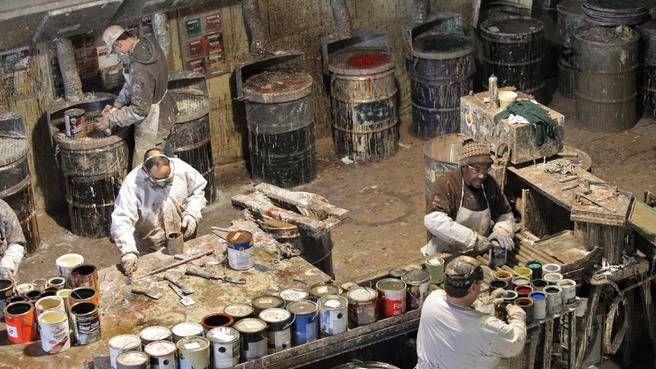
Time to impose our moral color to neutral human acts!
[Source]
To understand Value Theory, you can imagine that every person has two jars of paint, one jar with the color of "It's a value for me", and the other jar with the color of "It's not a value for me". Then, all human acts pass on a kind of conveyor belt, in front of the person. The acts on the conveyor belt have no color. For each act, the person choses subjectively what "moral color" he or she wants to give to this act, and then paints that act. So, for example, if the act called "rescuing abandoned kittens" rolls past, this person will reach for the "It's a value for me" jar of paint. But if the act called "beating up my grandmother" rolls pas, this person will reach for the "It's not a value for me".
Good, on the other hand, is more intrinsic to the thing; it is in things. If we reuse the metaphor of painting objects with two jars of paint, then the human acts which roll in front of us on the conveyor belt are pre-colored! Actually, it's more than pre-colored (because colored paint is just on the surface of the object). No, it's deeper. The actual material out of which each object is made is already a colored material, like a piece of anthracite coal which is black, even if you scrape it, even if you cut it in half, etc. You could try to paint the piece of coal with white paint, but the paint wouldn't stick, and the real color of the underlying object would eventually show through. Take the example of rape: rape is not a neutral act, and no paint from any supreme court could ever make rape into a good act.
Good is more objective than values. The Ancients defined good as: "that which perfects as an end". Evil is what is harmful to the thing (at least a lack of what is good). Whether a thing is good or evil has nothing to do with our taste. For example: food. Children can find a gallon of ice cream very tasty, and veggies very unpleasant, but the goodness or badness of that food is independant of their desires.
Even when we talk about values, we have to use the notions of good and evil (often in a covert way) to explain them. It's impossible to avoid value judgments, without avoiding internal contradictions. A society therefore ends up "imposing its values". Behind the facade of tolerance, there is always an implicit value judgment. We cannot live in peace with people who have the value of killing Jews, for example. It doesn't work.
Unfortunately, I neither have the space nor the skills to disprove Ethical Relativism in such a short essay. In the meantime, you can of course consult real philosophers. (I'm told C.S. Lewis' The Abolition Of Man is excellent on this topic.)
Good scouts don't have "values". Good scouts can see that truth exists, and they try hard to do good and avoid evil.
Let's Adore Jesus-Eucharist! | Home >> Philosophy