Semper paratus.
Let's Adore Jesus-Eucharist! | Home >> Varia >> Bachelor's Kit
Semper paratus.
Given some pretty scary worst-case scenarios, and some rather vague specifications, what could the solution look like, at least broadly? What follows are some general design rules, roughly classified and sorted as much as possible in decreasing order of importance.
All these design rules could be summarized thus: "Depend on God, Nation, and yourself; Stay mobile, simple, redundant and uninteresting".
As I mentioned in the introduction to the "Bachelor's Kit", this section of the web site targets some material aspects of life, but the spiritual life has such an effect on our material decisions, that I have to at least recall some spiritual principles here.
If your life is centered around some material good, like money, no "Bachelor's Kit" will save you. Material objects must serve us, and the treasure we have to store up must be in Heaven [Lc 12:33]. Yes, we need food, cloths, medication, etc., but "the Kingdom of God is not meat and drink" [Rm 14:17]. Idolatry of material objects takes many forms, for example "furniture-worshipping" (which means you need a huge apartment, large moving vans, expensive insurance, etc.), or "Attic-worshipping" (which means your living environment is transformed into a warehouse filled with the most useless clutter imaginable), etc.
Our material objects don't exist to give us everlasting happiness here on Earth. If you fall into this error, your material choices will be distorted. For example, you might place huge importance on an expensive home entertainment system, or a fancy summer cottage, or fall into "extreme survivalism" and waste your time preparing for "The End Of The World As We Know It" ("TEOTWAWKI"), etc. Being "prepared against disasters" is really nice, but don't forget that the worst disaster is going to Hell.
There isn't much use trying to come up with material objects or methods that will compensate for your spiritual diseases. If you are an alcoholic, for example, don't waste your time choosing the best mattress for the price. Whatever savings you might make will be wasted on beer. Get help first. I could give more examples, like somebody who is addicted to laziness and daytime TV (You won't be able to acquire the skills needed to get and keep a good job, if you waste your leisure time), or somebody who is so selfish and proud that nobody wants to share an apartment with him or her (which would greatly reduce their cost of living), etc.
This is the last "Spiritual Design Principle". It sort of sums up all the previous ones, as well as making us aware that the other extreme is possible, i.e. to try to solve material problems with spiritual remedies. For example, if what you need is a good job with a good paycheck, "Hail Mary's" are not enough. Another example: if you're too lazy and stupid to prepare for a disaster, don't try to hide behind Mt 6:25-34 ("Look at the birds in the sky; they do not sow or reap, they gather nothing into barns, yet your heavenly Father feeds them"), because saint Thomas Aquinas will hit right back with IIa-IIae, q. 55, a. 6 and 7 ("Go to the ant, O sluggard, and consider her ways and learn wisdom [... because she] provideth her meat for herself in the Summer, and gathereth her food in the harvest").
We are "social animals", as Philosophers say. We couldn't exist without society, and we wouldn't even be here if it hadn't been for the first "society" we were born into (our family). I can't list here everything that society gives us materially, since in a way it's everything! Think about the food you eat (you probably didn't grow it, or transport it to the market, etc.), or the clothes you wear, or perhaps the computer you're using to read this (imagine all the men who worked to invent computers!). I'll therefore only indicate a few rules that are sometimes forgotten.
Don't waste your money buying material objects in an attempt to "insulate" yourselves from social problems. Instead, get involved in Politics (of course, intelligently and virtuously). Good Politics can solve most material problems, and good Politics is often the only solution that can possibly solve a problem.
Often, we can simplify our material lives by participating in shared ownership of some objects. Some examples: sharing an apartment, public libraries, mass transit, buying one lawn-mower for many neighbors, tool rental stores, etc.
Some problems cannot be solved otherwise than by insurance. Remember insurance is just another manifestation of solidarity. Take for example fire insurance. We know every year "X number" of houses will burn down. So everybody contributes a little bit to a pot of money (i.e. insurance premiums), and that money is distributed to the unlucky few who lose everything that year because of fire. Therefore these unlucky few can once again become productive citizens, resume paying their insurance premiums, and the following year contribute to the recovery of the next unlucky few.
After God and Nation, your best defence is yourself, but yourself with a healthy mind in a healthy body ("Mens sana in corpore sano"). The necessity of a healthy body is obvious: just think about the horrible consequences of diseases (diabetes, cardio-vascular diseases, etc.). Not only must you return to your healthy body mass, but you also have to be «fit to fight», which implies a physical training program with the three standard components: aerobic exercises (like jogging, swimming, etc.), stretching exercises, and callisthenics (like sit-ups, push-ups and chin-ups, etc.). When it comes to surviving, your most important material weapon is your body.
For its part, a "healthy mind" is first of all a healthy will, in other words you must acquire all moral virtues, as we've just said. But a "healthy mind" also means acquiring what philosophers call "intellectual virtues" (these days people would use expressions like "knowledge" or "skills"). Some obvious examples of things you should learn and practice to improve your chances of survival in worst-case scenarios are:
- first aid;
- self-defense (e.g. how to avoid a confrontation, how to shoot a rifle, etc.);
- subsistence farming (e.g. how to grow a vegetable garden);
- handyman skills (e.g. how to build and maintain a shelter, how to
sharpen tools, how to fix your clothing, etc.);
- people skills (Yes, I'm serious. If you're courteous and charitable,
others will have a tendency to want to help you. The disabled turtle finishes
the race ahead of the athletic and insolent hare, because the turtle gets
a lift from passing motorists!)
- etc.
We won't discuss more about intellectual virtues here, but keep in mind it is a vast and critical category. Please refer to good books on these topics. (I myself am trying to build up a bibliography on these topics, but so far I've mostly wasted a lot of money to re-learn a lesson I already knew.)
Physical mobility is good, simply because if things get bad where we currently are, we can go somewhere else where things aren't so bad. I use the expressions "bad" and "go somewhere else" very broadly here. It can mean grabbing your bug-out bag and running out of a burning house in the middle of the night, or putting all your material belongings in a van and moving to another Province where there are more jobs, etc.
Here is another way of saying the same thing: "The cardinal rule to surviving a disaster is, whenever possible, to get out of its way!" [Bradley, Arthur T. Handbook to Practical Disaster Preparedness for the Family, 3rd Edition, 2012, p. 17] Why is that the cardinal rule of preparedness? Because problems that threaten us are either controllable by us, or not. If they are controllable, in other words if we can do something to make the threat stop, then we just make the threat stop! For example, if a big truck is coming down the street in your direction, threatening to kill you, you just step back onto the sidewalk and your problem is solved!
But if a threat is not controllable by you (like a nuclear bomb, or a pandemic, or an economic collapse, or in other words what we call a "disaster"), then the only thing you can do is to run away! Hence the importance of everything that can help you get out of there (i.e. "mobility").
Mobility is good, but some things are not "mobility". Being a coward and running away from your duty to face the enemy is not "mobility". Being selfish and abandoning the widow and the orphan is not "mobility". Conversely, putting all of your modular and well-organized and sexy and pretty survival equipment into a big box and sending it away to some friends far away who are experiencing a disaster is not a sin against mobility. On the contrary, it's a another reason for making your equipment mobile.
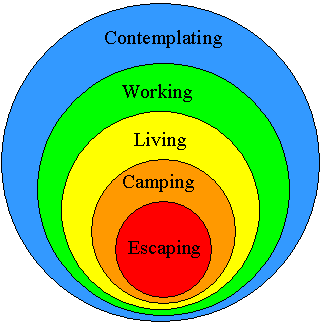
Figure 1: Overview of the structure
If you need to move quickly from point A to point B, you should be able to easily select a sub-set of your material belongings which is appropriate to the time you have to move. This structure also helps establish priorities for your purchase efforts (start with the smallest circle).
Some bad examples I've seen in other apartments: a huge and heavy sofa that unfolds into an (uncomfortable) bed, or very large and antique bookcases, etc. If you really need something big and heavy, buy the kind that you can easily dismantle into smaller parts that can be carried by one person.
When everything is going well, there are plenty of ways to get from Point A to Point B (cars, trains, city buses, airplanes, etc.). But in difficult situations when we really need to change places, those means of transportation are often unavailable. So it's probably a good idea to focus on improving your man-powered mobility (mostly walking and cycling). It is amazing how easy it is to get by without burning fossil fuels if you chose a well-located apartment or house, lose weight, and dress appropriately for the weather!
One of the disadvantages of mobility is that the more often and the quicker you move, the more you tend to lose parts. It's like shaking a rug vigorously! Anything not attached will fly off! Some general suggestions, in decreasing order of "materiality of attachment":
- Some objects should always attached to you (like your
keys).
- Many objects should often be attached together. A good example are
mittens, which already have a separate insulating layer and
a waterproof layer, and which are often removed (so you can tie your
boots or fiddle with your keys, etc.). Losing a part of a mitten can
be life-threatening (at night, in the winter, far from everything).
So good mittens have loops, and good parkas have clips at the end of
the sleeves.
- Even if objects are not attached with a rope to you or to each other,
they can be placed in a common container, which can be seen as a
kind of magic rope attaching them all. For example, the hygiene kit
(toothbrush, soap, razor, etc.), the bag with your spare socks and
mittens and tuque, etc. Ziploc bags and mesh bags are wonderful inventions.
- The good old checklist is also a way of avoiding losses. There should
be a
master list
somewhere, and every kit should probably have its own sub-checklist attached to
its containing bag or box. In an ideal world, I'd take a picture of all the
objects of a kit, and I'd print that picture onto the containing Ziploc! You'd
just need to lay out the Ziploc on the table and place all objects on it to
make sure you have everything.
- And of course, the less parts you have, the less parts you have to lose
(this is covered in the
section on Simplicity).
We said at the beginning: "Depend on God, Nation, and yourself; Stay mobile, simple, redundant and uninteresting". Simplicity has many advantages. Every additional material object means time to choose it, money to buy it, space to store it, effort to maintain it and carry it when you move, worries about theft and damage, etc. So minimize the number of your possessions.
Some examples:
- eating habits that are healthy but simple, and which eliminate cookbooks,
complex utensils and cookware;
- hobbies that are just as fun, but which require less objects;
- a hairstyle that eliminates comb, hair dryer and shampoo;
- souvenirs about your family and friends that bring back just as many good
memories, but that are much smaller, or even totally electronic;
- a normal spiritual life, instead of trying to fill your emotional void with a
dog, or cat, or a parakeet;
- etc.
As a quick rule-of-thumb, if you don't use something several times a year, get rid of it.
Of course, emergency equipment is an exception. (Like for example your car seatbelt, your first-aid kit, your smoke detectors, etc., in other words the objects you do not want to use!)
Computers and the Internet are wonderful. They can do much to help us simplify our lives. First, computers allow us to greatly reduce our use of paper (which is heavy and bulky). There is already a vast quantity of good books available free online. Many other books can also be purchased in electronic versions (like dictionaries). As technology improves, reading books on your computer will be more and more enjoyable. Other examples of paper reduction: scanning your picture albums and just keep the electronic version, or downloading the electronic version of your calculator's User's Manual and recycling the large paper copy, or adding a bookmark in your web browser pointing to some Government forms, instead of keeping the paper copies of those forms, etc.
(Of course, don't exaggerate. Some rare things should also be kept in paper format.)
Second, computers can also be used for entertainment. With a good pair of headphones, a laptop can be your only electronic entertainment device. You can watch good DVDs, listen to music, visit museums all over the world, etc.
You can often reduce the number of objects by making one object perform several roles. Some examples: a pail which double as a garbage can, a bed which doubles as a coat rack, etc. Another example is this whole "Bachelor's Kit", in which many objects do double-duty both for emergency survival, and common everyday use (examples: inflatable mattress made for camping, but confortable enough to use every day; dufflebag that can be connected to a packboard and carried as a backpack, or used daily as a dresser; etc.)
Of course, the most important of these technological advances is the computer, but there are many other cases. Some examples which happened to me: a battery-powered drill which is smaller and more powerful, a knock-down bed which replaced three pieces of furniture (bed, desk and closet), a comfortable folding rocking chair which replaced a large and heavy reading chair, a single-element countertop hotplate which replaced a large stove, etc.
Often, a category of objects can be accumulated indefinitely. You then have to choose an appropriate "Limiting Container", and stick to it. For example, you decide (based on your job) the number of linear centimeters of shelf space you really need, and build your bookshelves accordingly. (If a little voice in your head tells you: "But I'll always need more books!", you have a psychological problem, not a shelf space problem). Then, once your bookshelves are full, when you buy a new book, you have to take an old one out and give it to the local public library. You can also use this principle for music CDs, for cleaning supplies, your kid's toys, etc.
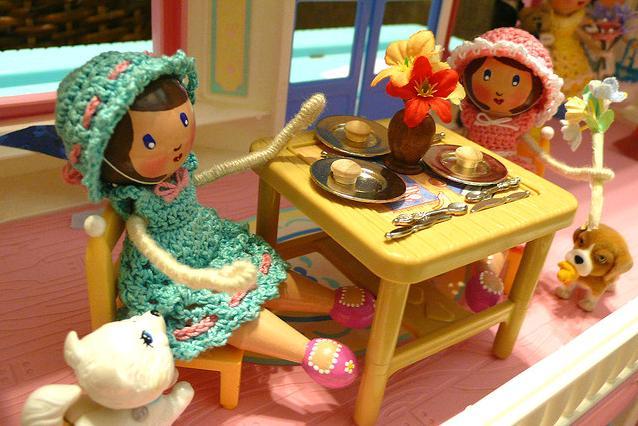
Some hemen who try to prepare for disasters fall into a strange psychological syndrom, which I guess you could call the "Doll House Pitfall". Have you ever seen little girls playing with their doll houses? They have tiny little tea cups, with a tiny little table and chairs, and tiny little spoons, and they imagine themselves facing problems, and then solving those problems with their cute and tiny little tools. "Oh! I need some tea!" Out comes the tiny little kettle. "Ah! I need some sugar!" Out comes the tiny little spoon, etc.
I had forgotten about this pitfall until a buddy showed me a guy's "EDC" (or "Every Day Carry", or mini-toolbox to solve all the emergencies which can befall you in a difficult situation). It was amazing. He had tiny little tubes of mouthwash, tiny little saws and knives, tiny little screwdrivers, and even a tiny little spoon! He had an amazing amount of stuff crammed into a small pouch. It was very small and handy, which means it was very mobile, but it was also very useless (unless you imagine yourself facing problems, then imagine yourself solving those problems with your cute and tiny little tools).
Here is a more detailed argument against the "Doll House Pitfall". One of the most important items to be carried in any emergency kit is some kind of waterproof jacket and pants (the jacket must have a hood, and it's probably a very good idea to include waterproof gloves and socks in a pocket of that jacket). Hypothermia can kill within a few hours (a few minutes if you are in cold water). On the other hand, you can survive weeks without any food. The smallest thing that can still have some chance of keeping you vaguely warm is something that blocks wind, rain and snow. But even if they are made of a high-tech fabric, your tightly-packed jacket and pants will already be bigger than the whole "Doll House" kit here above.
Another way of saying the same thing is the old proverb: "Keep it simple, as simple as possible, but no simpler". If you need a piece of equipment to survive, and you've made efforts to get the smallest and lightest version of that piece of equipment, that was still robust enough to do the job reliably, then you have to carry that piece of equipment. Don't "simplify" by removing essential stuff that you find big or ugly. Don't fool yourself into imagining you can solve problems, just because you have a nice kit filled with cute and tiny optical illusions.
To reduce vulnerability to failures, component redundancy is necessary. The usual saying is: "Two is one, and one is none". (Another way of putting it, which has helped me recently in some buying decisions, is: "If you can't afford two of those, then you can't afford one of them".) This redundancy can be direct, indirect, or potential.
Examples: the flashlight, which is so important, and neither too heavy or bulky or expensive to have two of them. Same thing for the toque, mittens and wool socks.
Examples: the jacknife can up to a certain point replace the knife, or the raincoat (with several thin insulating layers underneath) which can replace the winter parka, or coat sleeves that are long enough so you can grab them with your hands and close them off to keep your hands warm and be able to sort of grab cold objects when you forget your gloves, etc.
If you have an emergency fund (normally provided by some kind of insurance), and a kind of "micro-film" of all your belongings (the backup copies of your data, and the Internet to get access to this "Bachelor's Kit"), you can rebuild your whole material environment, exactly as it was!
I've said above how important it was to have solidarity with our fellow men. Unfortunately, since Original Sin, some of our "fellow men" are also our enemies. We need to protect ourselves from murderers, theives, rapists, etc. (I include "Leftist Government bureaucrats" in that "etc.".)
I'm no expert on self-protection, but making oneself uninteresting seems a good approach. By "uninteresting", I mean being unattractive, repellant, and even better, absent. Actually, I was reading a book that explained how to deal with bear attacks, and much advice seemed to be perfectly transferable to man attacks:
7.1) Remove attractants: For bears: Don't carry tasty food on you, don't eat in your tent, and don't store food close to your tent. For bad men, you could say: don't look too rich (jewelry, fashionable cloths, fancy car) or too poor (poor people are easy prey). Don't look too ready for combat (attracts police attention) or not enough (attracts criminal attention). Don't say things about yourself (where do you live? what is your schedule? what's in your house? etc.).
7.2) Add repellants: For bears: Travel in groups (statistics on bear attacks show that as soon as you're not alone, attacks are greatly reduced, and if you're more than four, they are almost inexistant). For men, same thing! Think about it: what is the human thing least likely to be attacked? A big army!
Let's continue. For bears: put bars of a steel cage between the bear and you. For men: lock up your car, put a chain on your bicycle, install a more solid door on your house, etc. For bears: fight back if your attacked, using whatever you have available that can be used as a weapon (bears are looking for an easy meal, not a bloody fight). For men: same thing! But make an effort right now to get yourself properly equipped with "sharp teeth and big claws"...
7.2) Become absent: To avoid encounters with bears, or bad men, you need both static and dynamic avoidance:
7.2.1) Static avoidance: For bears, don't go deep into the forest: that is their favorite territory! For bad men, don't do dumb things, in dumb places, at dumb times: that is the favorite "territory" of bad men! (If you go partying with morons and return home alone in the middle of the night, you don't need a gun; you need common sense.)
7.2.2) Dynamic avoidance: Because both bears and bad men can travel outside their usual territory, you need to maintain "situational awareness" or "circumspection". For example: don't go around with your neck bent 90 degrees down because you're futzing around with your "smart" telephone. Rather, often swivel your neck 360 degrees so you can see behind you. Another example: expect ambushes. Predators know they should hide their trap at the end of some kind of "one-way funnel". For example, during a drought, a bear might hide in a bush, next to the only drinking spot left in the forest, and in such a way that the poor deer ends up with on one side a steep cliff, and on the other side a hungry bear! For bad men, it can get very complicated, but the general idea remains the same. If you feel discreetly directed to a specific location (the gradually narrowing "one-way funnel"), and this specific location has convenient hiding places (bushes, buildings, a turn in the road or the corridor which prevents you from seeing far ahead, etc.), run away while you can.
Unfortunately, bad men can also travel virtually, i.e. they can attack you in far more ways than just jumping on you and biting your head off like a grizzly. So dynamic avoidance can get very complicated. For example: Don't keep all your money in the bank if your currency starts to behave strangely. Don't put your private information on an electronic device controlled by bad men. Don't stay in a Country devolving into a tyranny, etc.
Let's Adore Jesus-Eucharist! | Home >> Varia >> Bachelor's Kit